Virtual Physiotherapy: What Strength Athletes Can Expect
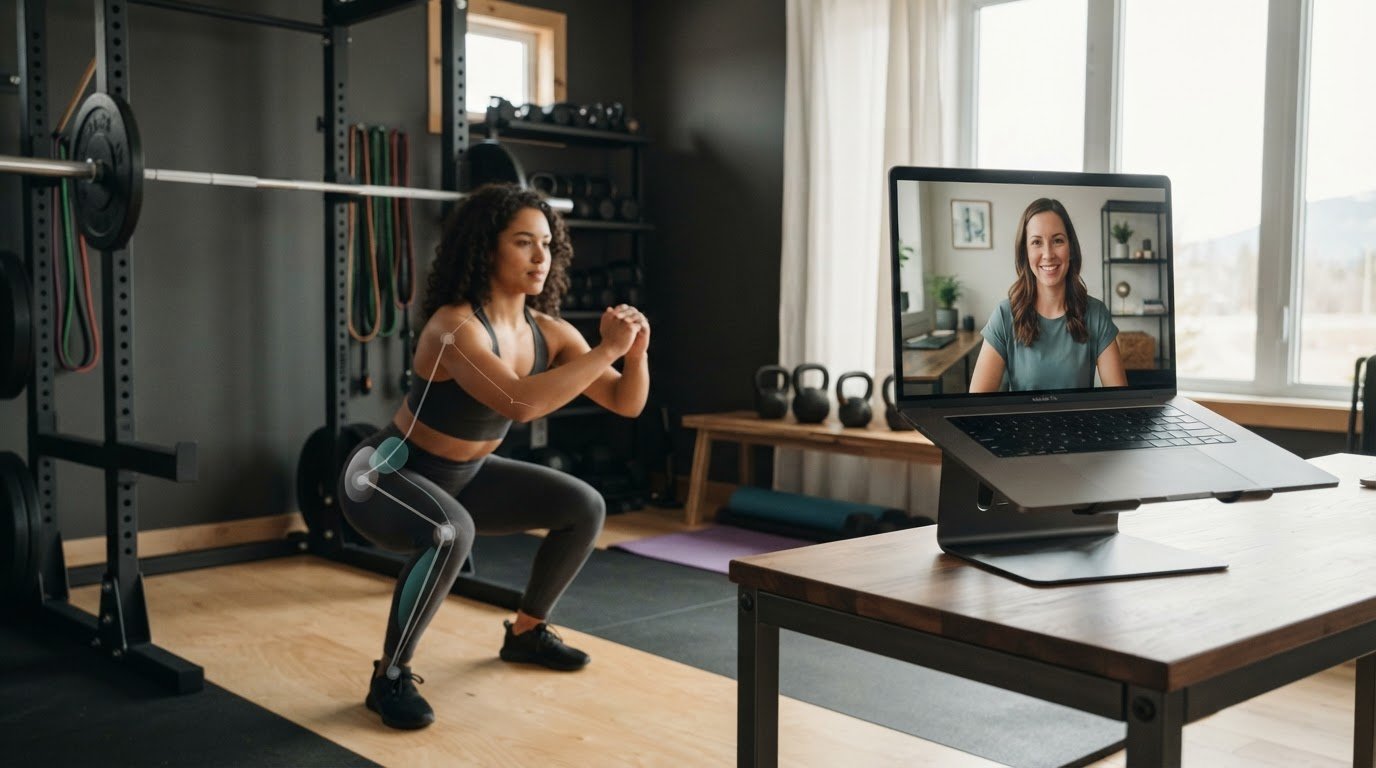
Can a video call help you figure out why your squat hurts or your press has stalled? Virtual physiotherapy can help a physiotherapist assess how you move, even when you train at home or in a gym. The value comes from connecting that assessment to your lifts, symptoms, and performance goals, rather than handing you a generic exercise list.
It’s fair to wonder what a physiotherapist can assess through a screen. They can ask about your training and symptoms, watch you perform relevant movements, and assess range of motion and strength through functional tasks and equipment you have available. They can’t perform a hands-on examination or treatment, so virtual care has limits. Clear communication and useful movement observations help guide the next steps.
In this article, you’ll learn what to expect from an online assessment, what it can and can’t address, and how personalized analysis can shape injury treatment and rehabilitation around your training. You’ll also learn how a plan can help you adapt your lifts while managing symptoms, with progressions that respect your goals and support a return to the activities you want to do.
Key Takeaways
- Learn how virtual physiotherapy can connect your lifting concern, movement assessment, and next steps.
- Understand what a video assessment can reveal about movement and what it cannot establish without a hands-on examination.
- See how your training history, symptom patterns, and goals can shape a more relevant care plan.
- Find out how recommendations can account for your current training demands instead of relying on a one-size-fits-all exercise list.
- Explore how PhysioParth’s personalized analysis, injury treatment, and rehabilitation programs support strength athletes and powerlifters.
What virtual physiotherapy means for strength athletes
Virtual physiotherapy is a clinician-led appointment held by video. You discuss a concern, observe relevant movement, and work together on next steps. It isn’t a self-guided workout library or a recorded set of exercises. A physiotherapist uses your history, symptoms, and training goals to guide the conversation and shape an individualized plan. The appointment happens online, but the assessment and guidance are specific to you.
Telehealth is a broad way to deliver health services remotely, including through video appointments. This Telehealth overview provides background on the approach. For a lifter, the important part is how the clinician connects what you describe with what they can observe. You can explain when a symptom appears, demonstrate a movement that feels different, and discuss how training demands and recovery fit into the picture.
How virtual physiotherapy differs from an online exercise plan
An online exercise plan may offer a fixed sequence of movements. A virtual appointment starts with your situation. The physiotherapist asks about your training history, what has changed, which movements bring on symptoms, and what you want to return to doing. That context helps make the discussion relevant to your lifts instead of treating every sore shoulder or uncomfortable squat the same way.
Exercise demonstrations show how to perform a movement. Clinician-led guidance considers why a movement might suit your current needs, how to adjust it, and what to monitor as you train. The aim isn’t to hand you a generic list. It’s to help you understand your options and agree on practical next steps based on your assessment.
Why strength athletes may consider virtual care
A change in squat tolerance can make you rethink your stance, depth, or weekly loading. Pressing discomfort might affect training and everyday tasks, such as reaching overhead. In either case, a video appointment gives you time to explain what you’ve noticed and discuss the movements that matter to you. You can also talk through your training setup and current routine, connecting the concern to your day-to-day function.
That conversation can help you consider training and recovery priorities together. For example, you might discuss how symptoms respond across a training week and what adjustments could keep your goals in view while you work through the issue. Online care can’t provide hands-on examination or treatment, but an individualized discussion can help replace guesswork with a clearer plan.
Online appointments can fit around work, training, and recovery without a trip to an in-person clinic. Flexible scheduling makes it easier to access tailored support and bring your training context into the conversation. For strength athletes balancing a demanding routine, that can help make care planning more practical.
How virtual physiotherapy assessment connects movement to a care plan
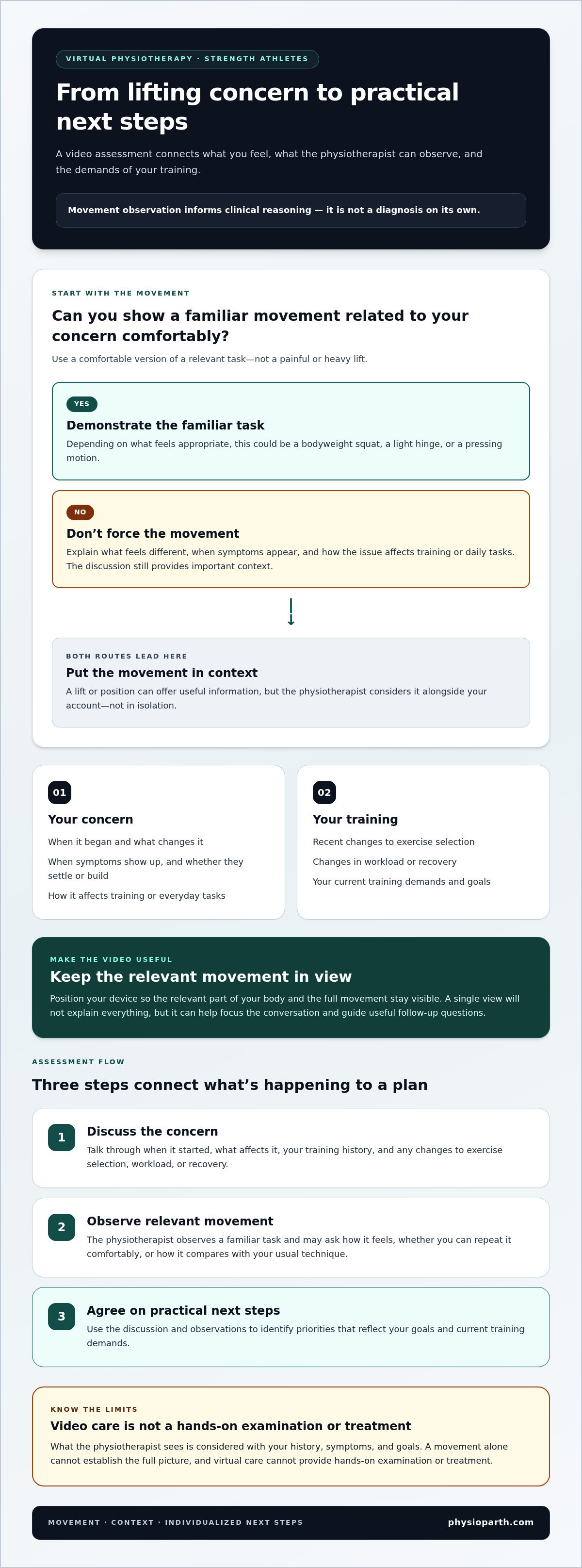
A useful assessment follows a clear sequence: discuss what’s happening, observe movements related to your concern, then agree on next steps. In virtual physiotherapy, this helps connect what you feel under the bar with what the clinician can observe and the demands of your training. Movement observation informs clinical reasoning, but it doesn’t replace it. Findings are considered alongside your history, symptoms, and goals, not used as a diagnosis on their own.
- Discuss the concern. Describe when it began, what changes it, and how it affects training or daily tasks. Your recent training history adds context, including changes in exercise selection, workload, or recovery.
- Observe relevant movement. The physiotherapist may ask you to demonstrate a familiar movement related to the concern. Depending on what feels appropriate, that could be a bodyweight squat, a light hinge, or a pressing motion.
- Agree on next steps. You and the physiotherapist use the discussion and observations to identify practical priorities. Recommendations can reflect your current training demands and the goals you’ve shared.
The lift itself isn’t a shortcut to an answer. A change in squat depth, deadlift setup, or pressing position may give the physiotherapist useful information, but it needs context. They’ll consider what you feel, when symptoms appear, whether they settle or build, and how the issue affects your training. Two athletes can show a similar movement and need different next steps.
What a physiotherapist may observe over video
Camera placement can make a movement easier to assess. Position your device so the relevant part of your body and the full movement stay in view. Demonstrate a comfortable, familiar version of the task rather than forcing a painful or heavy lift. What the clinician sees contributes to the assessment alongside your account of symptoms and training history.
Small details can prompt useful follow-up questions. The physiotherapist may ask whether a position feels different, whether you can repeat the movement comfortably, or how it compares with your usual technique. A single video view won’t explain everything, but it can help focus the conversation and clarify what needs further exploration.
How assessment findings guide individualized next steps
Recommendations should connect to your priorities, not an assumed lifting template. If maintaining a particular training movement matters to you, discuss that goal and the demands of your current program. The physiotherapist can use that context to shape guidance, then adjust it as you report how your symptoms and function respond. Your plan develops through that feedback rather than following a universal lifting protocol.
Share what you want to return to, along with what your training week looks like. That gives the assessment a practical target. PhysioParth’s personalized physiotherapy care is centred on strength athletes and their individual lifting context.
Can virtual physiotherapy assess lifting pain effectively?
Yes, video can help a physiotherapist assess many lifting-related concerns, but it has clear limits. A clinician can ask how your symptoms behave and observe relevant movements. They can’t perform a hands-on examination through a screen, and a movement clip alone can’t confirm a diagnosis. Virtual physiotherapy is most useful when your concern, the information you share, and what the physiotherapist can observe provide enough context to guide safe, practical next steps.
Think of the assessment as gathering pieces of a clinical picture, not running a single test to find a definitive answer. Your description of pain during a deadlift, for instance, may be considered alongside when it starts, how it changes after training, and what you can do comfortably. A squat or press observation can add context, but neither proves the cause of pain on its own.
| Assessment element | What video may contribute | What it can’t establish alone |
|---|---|---|
| Symptom discussion | When discomfort occurs and how it affects lifting or daily activity | A physical finding that requires hands-on assessment |
| Movement observation | How a familiar movement looks and which positions bring on symptoms | The cause of pain based on one movement or camera angle |
| Clinical decision-making | Information to help shape training guidance and next steps | Every detail a broader examination may require |
What video assessment can help clarify
A focused conversation can help identify patterns: whether symptoms appear during a particular part of a lift, change with load or range, or linger after training. The physiotherapist may then observe a comfortable version of a relevant movement and ask what you feel as you perform it. Together, those details can guide a working clinical picture and a practical discussion about training. They don’t turn a movement into a stand-alone diagnostic test.
That context matters for lifters. If your pressing feels different near the bottom of the movement, for example, the conversation can explore how that affects your training and what you’ve already noticed. The observation may inform the discussion, but it doesn’t prove why the discomfort occurs.
When an online assessment has limits
Video can’t provide touch-based assessment or every method a physiotherapist might use to examine a concern. A poor internet connection, an obstructed view, or a camera angle that misses the relevant movement can also limit what the clinician sees. Reposition your device or describe the movement if needed, though some questions may remain unanswered remotely.
Suitability depends on the concern and the information available. If the physiotherapist can’t assess the issue confidently through video, clinical judgement guides what happens next. That may mean refining the questions, changing the movement being observed, or discussing a different assessment approach. The goal is to recognize what the available information supports and set appropriate boundaries around the guidance.
What to expect from a virtual physiotherapy plan for training
A useful plan should give you direction without treating your training like a problem to eliminate. It’s developed through discussion between you and your physiotherapist, with recommendations shaped around your symptoms, goals, and current demands. It may include rehabilitation exercises, strategies for managing training, or guidance on building capacity over time. The details depend on your assessment and how you respond, not a preset exercise list.
In virtual physiotherapy, the plan needs to make sense in your actual week. Share what you’re training, what you’ve modified, and which lifts or activities matter most. A powerlifter preparing for a meet may prioritize maintaining competition movements where appropriate. Another athlete may focus on returning to regular training or making daily tasks more comfortable. These priorities help frame progress beyond a symptom score alone.
How a plan can fit around an athlete’s goals
Training context helps turn broad advice into practical choices. Your physiotherapist may consider your current routine, recovery priorities, and the movements you want to keep working toward. Together, you can discuss which activities feel manageable, what might need adjustment, and what signs to monitor. The aim is a plan that respects your goals while responding to your current tolerance, not a guaranteed return date or fixed outcome.
Meaningful progress can look different from one athlete to another. You might track how comfortably you complete a daily task, how symptoms respond after a session, or whether you can gradually work toward a movement that matters to you. These observations can help you and your physiotherapist decide whether the plan still fits. They also keep the focus on function and training, not just a single measure of pain.
Recommendations may change as your needs become clearer. An exercise that feels manageable can be progressed; a movement that aggravates symptoms may call for a different approach. That doesn’t mean abandoning your goals. It means using your response as useful feedback and adjusting the plan rather than forcing a standard progression.
How follow-up can guide progress
Follow-up gives you time to share what has changed since the last discussion. Note how symptoms respond during training, later that day, and during recovery. Bring questions about exercises or modifications, including what feels useful and what doesn’t fit your routine. Clear feedback helps your physiotherapist understand your response and refine recommendations for your progress and tolerance.
Ongoing review can connect rehabilitation with recovery and performance goals. The focus stays on building a workable path, checking how it fits, and adapting as your situation changes. For strength athletes, that means keeping the broader training picture in view while addressing the issue at hand.
If you’re looking for a plan shaped around your lifting goals, learn more about virtual physiotherapy with PhysioParth.
How PhysioParth delivers virtual physiotherapy for lifters
PhysioParth provides virtual physiotherapy for strength athletes, powerlifters, and active individuals. The focus is on understanding the person behind the lift: what’s changed, what training looks like now, and what you want to keep working toward. A concern that affects a powerlifting session may also influence recovery, confidence, or everyday function, so those details help shape the care discussion.
Care includes personalized analysis, injury treatment, and rehabilitation programming. These elements connect: analysis helps make sense of your situation, while treatment and rehabilitation planning address your needs in the context of your goals. Recommendations are tailored to you, not pulled from a standard lifter’s template. The aim is to build a considered path that fits your circumstances.
A strength-athlete-focused approach
Your lifting context gives the conversation direction. Share which movements you’re training, what feels different, and what you’re trying to maintain or regain. A powerlifter’s priorities may differ from those of someone training for general strength or staying active around a demanding work schedule. That background helps PhysioParth make personalized analysis relevant to your life and training, while respecting your knowledge of your own body.
Bring the practical details, too. Explain how the issue affects your sessions, recovery, and activities outside the gym. The physiotherapist can use that information to guide injury treatment and rehabilitation recommendations. Your plan should be specific to your situation, with room to discuss questions and preferences as care progresses. Your training goals help set the direction, while your response informs the next steps.
Taking the next step with virtual care
Online care may suit lifters who want an individualized discussion about a training-related concern, with support that considers rehabilitation and performance goals. Virtual appointments provide access to tailored care without travelling to an in-person clinic. PhysioParth offers flexible scheduling and same-week appointment availability, making it easier to plan around work, training, and recovery.
Before your appointment, think about what you want help with and what you hope to do more comfortably. You don’t need a perfect summary. A clear account of what’s changed and what matters to you gives the conversation a useful starting point. From there, you can work with the physiotherapist to understand your options and identify an appropriate path forward.
Ready to take a practical next step? Book a virtual physiotherapy appointment with PhysioParth and start a care conversation shaped around your lifting goals.
Make your next training decision with a clearer plan
Pain can make every training choice feel like a trade-off: keep lifting as planned, change the session, or step back and reassess. A focused conversation about what you’re experiencing and what you want your training to look like can help you make that decision with more context.
Before an appointment, note what you’d like help with, what you’ve already changed, and which activities matter most to you. You don’t need perfect answers. Those details give your physiotherapist a starting point for a plan that considers both your symptoms and your goals. With virtual physiotherapy, you can work toward a more informed approach while keeping your progress in view.
Book a virtual physiotherapy appointment with PhysioParth to start building a path that makes sense for you.
Frequently Asked Questions
Is virtual physiotherapy effective for strength athletes?
Virtual physiotherapy can be useful for strength athletes when the clinician can assess the concern through discussion and movement observation. It may help you explore how symptoms relate to training, daily activities, and recovery, then consider appropriate next steps. Its usefulness depends on the concern and the information available. Since video can’t provide a hands-on examination, it won’t suit every assessment need, and no format can guarantee a particular result.
Can I use virtual physiotherapy if I train at a commercial gym?
Yes, you can attend a virtual appointment from a commercial gym if you have a private-enough space, a reliable connection, and a device positioned to show the movement being discussed. You don’t need to film your entire workout. A quiet corner or another suitable space may make it easier to talk through your concern without background noise. Follow the physiotherapist’s guidance before demonstrating movements or using gym equipment.
Do I need a doctor’s referral for virtual physiotherapy in Canada?
A doctor’s referral isn’t universally required to book physiotherapy in Canada, but requirements can vary by province and by your insurance plan. Some plans may ask for a referral before reimbursing treatment, even if you can arrange an appointment directly. Review your extended health benefits for referral rules and any documentation requirements. If you’re using another type of coverage, check its eligibility criteria before your appointment.
Does insurance cover virtual physiotherapy in Canada?
Coverage depends on your plan. Some extended health benefit plans include physiotherapy, while reimbursement rules may differ for virtual appointments, annual limits, or referral requirements. Review your policy for telehealth eligibility, required receipts, and any limits that apply to physiotherapy. If you have coverage through work, your benefits booklet or insurer can clarify the terms. Don’t assume an appointment is covered until you’ve reviewed your specific plan.
How much does virtual physiotherapy cost?
There’s no single Canada-wide fee for virtual physiotherapy. Costs can vary by provider and appointment type, and insurance reimbursement may reduce your out-of-pocket expense if your plan covers the visit. Review the appointment details for the applicable fee before booking, and check your benefits to understand what you may be able to claim. Avoid comparing prices alone; consider the assessment and individualized care included in the appointment.
What equipment do I need for a virtual physiotherapy appointment?
You’ll need a phone, tablet, or computer with a camera and microphone, plus a stable internet connection. Set the device somewhere secure, with enough space to move if your physiotherapist asks you to demonstrate an activity. Keep any usual training equipment nearby only if it’s relevant and you’re asked to use it. You don’t need to perform a heavy lift or test your limits for the appointment.